


I. The woman in Frankfurt
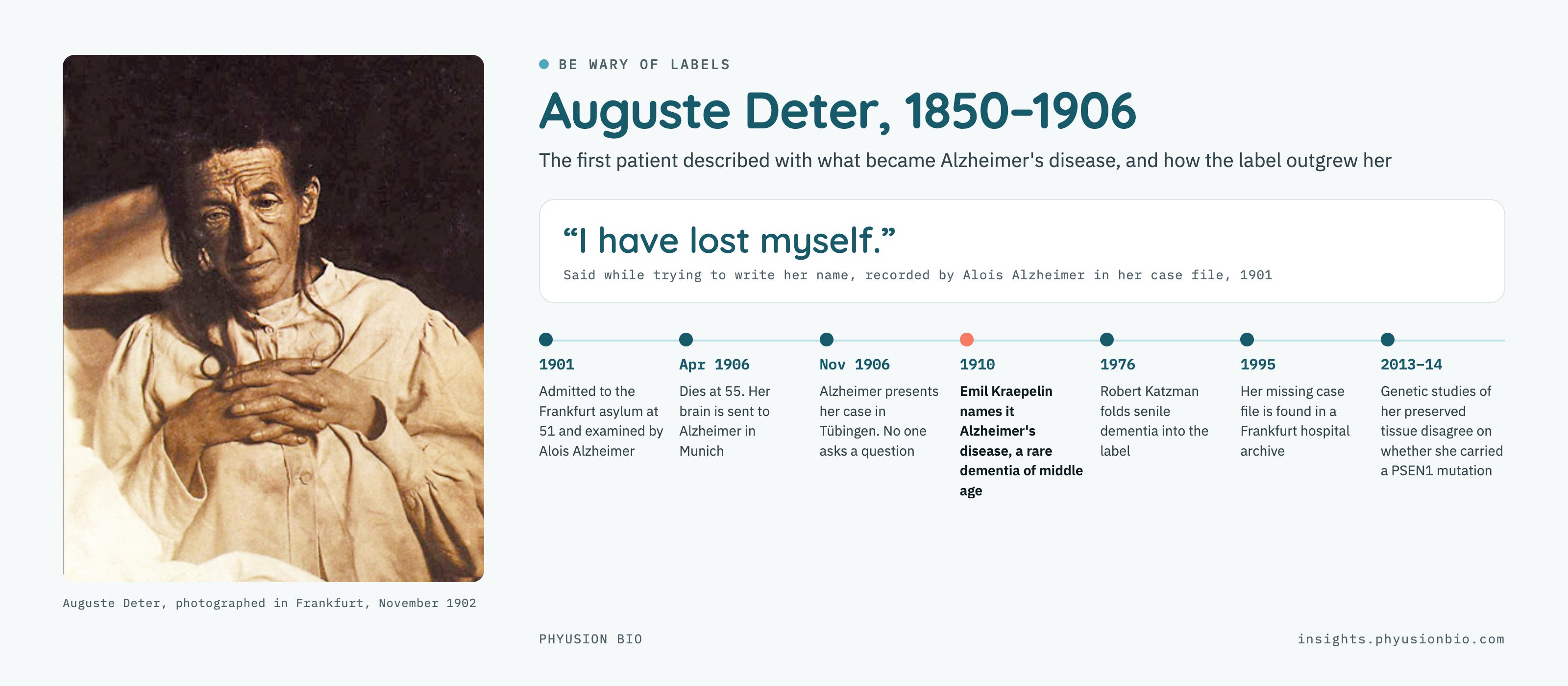
On November 25, 1901, a 51-year-old woman named Auguste Deter was admitted to the municipal asylum in Frankfurt. She was disoriented and suspicious, and she could not hold a thought long enough to finish it. The physician who examined her, a young psychiatrist named Alois Alzheimer, asked her to write her name. She began and could not finish. “I have lost myself,” she said as she tried. Her case file, missing for most of the twentieth century, was rediscovered in a Frankfurt hospital archive in 1995.
Auguste Deter died in April 1906. Alzheimer, by then working in Munich in the laboratory of Emil Kraepelin, the most influential German psychiatrist of his time, had her brain sent to him. Under the microscope he found what would become the two signatures of the disease: plaques between the neurons and tangled fibrils inside them. That November he presented the case at a meeting of psychiatrists in Tübingen. No one asked a question and the local press gave the lecture two lines.
Four years later, Kraepelin gave the condition a name. In the eighth edition of his textbook, he called it Alzheimer’s disease. Historians still debate why he declared a new disease so quickly on the strength of a few cases. The scope of the label, however, was clear. It described a rare dementia of middle age, separate from the ordinary senility of old age.
For more than half a century, that is what the term meant. Then, in April 1976, Robert Katzman, a neurologist at Albert Einstein College of Medicine, published a two-page editorial in Archives of Neurology arguing that the distinction made no sense. The plaques and tangles of older patients looked like those of younger ones. Senile dementia, he concluded, was Alzheimer’s disease. With that reclassification, a rare condition became, by his estimate, the fourth or fifth leading cause of death in the United States. Federal funding for Alzheimer’s research grew from about $5 million in 1980 to $647 million in 2005. After Congress added $100 million for fiscal year 2026, annual NIH funding for Alzheimer’s and related dementias passed $3.9 billion.
Katzman had good reasons to want dementia in older people taken seriously. But it’s worth underscoring what happened. Nothing in the biology changed in 1976. The label changed, and the label then decided what everyone would look for. A category drawn around one woman’s brain, named in one man’s textbook and enlarged by another man’s editorial became a single disease with a presumed single cause. Nearly everything since has been studied inside it.
A label is a human judgment that hardens into infrastructure. It sets the inclusion criteria for trials, the endpoints regulators accept, the codes on death certificates and the categories in every dataset built afterward. Some of the questions it frames lead somewhere. Many lead into dead ends that take decades to recognize, because the label itself is rarely what gets tested.
II. Heroes and villains
This week, Nature ran a news feature by the science journalist Alison Abbott on people who resist dementia. It’s careful reporting about serious science. Henne Holstege, a geneticist at Amsterdam University Medical Center, spent five years having grants rejected before she could begin studying the very old who stay cognitively intact. Her field has since identified a dozen or so rare variants linked to resilience, with evidence that varies widely in strength. Several sit in APOE, the gene that carries the strongest common genetic risk for late-onset Alzheimer’s. One, found in an Icelandic cohort in 2012, sits in the gene for the amyloid precursor protein. Another, in the gene for fibronectin 1, points to the walls of the brain’s blood vessels.
If we read the piece for the vocabulary it uses, a story appears underneath the science. The resilient variants seem to possess superpowers. The brain has defense mechanisms against toxic proteins. One allele dials risk up and another dials it down. Variants confer resistance, protect us and do so safely. Near the end, Laura Nisenbaum of the Alzheimer’s Drug Discovery Foundation describes a rare variant as “nature showing us a drug target that already works in a human being.”
In genetics, “protective” has a narrow technical meaning: a variant is associated with lower odds of a defined outcome in a defined population. As shorthand, it is defensible. But scientific shorthand compresses complex phenomena, and the compression hides its assumptions that can be arbitrary or misguided. This one assumes that there is actually a disease, that it has a cause, that the cause is known, and that each variant stands either with us or against us. Each of those is a claim about biology. None has been settled, and the last is not the kind of claim biology can settle. APOE4 shows us why.
III. The ancestral allele
APOE4 is the variant the Nature article (and many others) cast as the villain. In a 1997 meta-analysis of 5,930 patients and 8,607 controls, Lindsay Farrer of Boston University and colleagues found that among people of European ancestry, one copy of APOE4 raised the odds of Alzheimer’s about threefold relative to the most common genotype, and two copies raised them far more. Yet APOE4 is not a recent “error.” Sequence analysis led by Stephanie Fullerton, then at Pennsylvania State University, indicates that APOE4 is in fact the ancestral form of the gene. APOE3 and APOE2 are derived from it, and APOE3 spread only over the past 200,000 years. For most of human evolution, APOE4 was the norm.
In 2017, a team led by Ben Trumble, an anthropologist at Arizona State University, studied 372 Tsimane, forager-horticulturalists in the Bolivian Amazon who live with heavy parasite burdens. Among people without APOE4, a high parasite burden went with poorer cognitive performance. Among older APOE4 carriers with the same burden, cognition held steady or slightly improved. The allele that predicts decline in Boston appeared to preserve cognition in a river village where infection is constant.
Late-onset dementia usually appears after the reproductive years, when natural selection has little left to act on. Michael Gurven, an anthropologist at the University of California, Santa Barbara, and a coauthor of the Tsimane study, has noted that an allele can persist despite causing harm late in life, particularly if it confers some advantage earlier. To natural selection, APOE4’s late-life effects were close to invisible.
APOE4, then, is neither a risk gene nor a protective one. Its effects depend on the environment it meets, the age at which it is measured and the outcome we choose to count, and the label “risk allele” folds all three into a verdict that mentions none of them. The Nature piece offers its own reminder: W276C, one of the protective variants it describes, has so far appeared only in a cohort of Native American ancestry, which suggests that a variant’s meaning travels with the population and setting in which it was found.
IV. The anomalies
The Nature article frames Alzheimer’s the standard way: amyloid clumps into plaques, the plaques set off inflammation and tau tangles, and the brain degenerates. If plaques start the process, people with plaques should eventually develop dementia. Many do not. A 2015 meta-analysis in JAMA of 55 studies, led by Willemijn Jansen and Pieter Jelle Visser in the Netherlands, found that amyloid positivity among cognitively normal people rose from 10% at age 50 to 44% at age 90.
The most famous exception is a woman from Antioquia, Colombia. She belongs to an extended family that carries PSEN1 E280A, a mutation that drives early-onset Alzheimer’s with near certainty. Carriers typically show cognitive impairment around age 44 and dementia around 49. She stayed cognitively intact into her seventies. In 2019, a team led by Joseph Arboleda-Velasquez of Mass Eye and Ear, Yakeel Quiroz of Massachusetts General Hospital and Francisco Lopera of the University of Antioquia reported in Nature Medicine that she carried two copies of the APOE3 Christchurch variant. Her brain carried an unusually heavy amyloid burden. Her tau burden was low, and her brain metabolism looked healthy.
Inside the amyloid frame, she was protected from the consequences of her plaques. Outside it, she is evidence that plaques were not sufficient to produce her disease, and that whatever tracked her cognition lay somewhere else.
Even this anomaly deserves the scrutiny we would give any hypothesis. In August, an investigation in Science by the reporter Charles Piller raised concerns about how the research team identified its protective variants, including changes to patient data and apparently altered or duplicated images in several papers. Those questions are not settled, and laboratory work from other groups still suggests the Christchurch variant changes how ApoE behaves. But if the concerns hold up, some of the field’s most celebrated protective variants may prove to be partly products of the story researchers wanted to tell. The label cuts both ways. “Protective” can seduce as easily as “risk” can condemn.
The drugs tell a similar story. Lecanemab and donanemab remove plaque with remarkable efficiency. In the CLARITY AD trial, lecanemab slowed decline on the CDR-SB, an 18-point clinical dementia scale, by 27% over 18 months, a difference of 0.45 points. In TRAILBLAZER-ALZ 2, donanemab slowed decline by 35% on its primary measure in patients with low to intermediate tau. Both have a risk of brain swelling and microbleeds, and whether patients and families can feel the benefit remains in dispute. Then, in June 2024, Nature retracted a 2006 paper by Sylvain Lesné, Karen Ashe and colleagues at the University of Minnesota that had tied a specific amyloid species, Aβ*56, to memory loss. The paper had been cited more than 2,000 times, and Ashe, its senior author, acknowledged that figures in it had been manipulated. Lesné disagreed with the retraction. Defenders of the amyloid hypothesis are right that the retraction did not refute it but it did show how much weight the field had placed on a single result.
Thomas Kuhn, the physicist turned historian of science, argued in The Structure of Scientific Revolutions that scientists rarely abandon a paradigm when they meet an anomaly. They adjust the theory or set the anomaly aside until the exceptions become too many to manage. The resilience literature does something quieter. It names each exception: cognitive reserve, a protective variant, a super-ager. The anomaly becomes a property of the person rather than a problem for the theory. Resilience is what we call an anomaly once we have decided it belongs to the patient and not to the model. It’s a convenient way of protecting our biases.
V. Junk, drivers and other verdicts
Biology has paid for this habit before. In 1972, Susumu Ohno, a geneticist at City of Hope in California, published a paper titled “So much ‘junk’ DNA in our genome.” Ohno meant something specific, and historians of genetics still argue about how far later readers stretched it. The word did its own work anyway. Wojciech Makalowski, a computational genomicist then at Pennsylvania State University, later wrote that the term kept mainstream researchers away from noncoding DNA for years. Regulatory elements, noncoding RNAs and transposons that shape how genes are expressed spent part of that time in a bin labeled trash.
In oncology, we have a more recent version. In 2018, Iñigo Martincorena and Phil Jones of the Wellcome Sanger Institute sequenced normal esophagus from nine organ donors aged 20 to 75. By middle age, clones carrying mutations in cancer genes had colonized much of the tissue. NOTCH1 mutations were present in 12% to 80% of cells, several times more common in normal esophagus than in esophageal cancer. A mutation filed as a cancer driver was more at home in healthy tissue than in tumors.
Three years later, Bartomeu Colom, Jones and colleagues showed in mice that mutant clones in normal epithelium outcompete and eliminate most emerging tumors. Whether a nascent tumor survived depended not only on its own mutations but on the fitness of its neighbors.
“Driver” was a verdict reached by looking only at tumors. Once the tissue was described as it is, a rule became visible. Clones compete for space, selection depends on the neighborhood, and the same mutation can expand a tumor in one setting and crowd one out in another. That rule says more about cancer than the verdict ever did.
VI. The universe is indifferent
Each of these labels assigns a value before the description is finished. APOE4 is a risk. Christchurch is protection. Noncoding DNA is junk. NOTCH1 is a driver. The plaque is toxic. Each verdict sounds like a finding, and each one narrows what a researcher thinks is worth examining next.
But nature makes no such assignments. An allele does not harm or protect. A plaque does not attack. A clone doesn’t betray the tissue it came from. Each follows the same rules of chemistry, selection, competition and energy that govern every other process in the body. Nature is indifferent in every direction. It has no preference for our survival and none against it.
The French philosopher and physician Georges Canguilhem worked through a version of this problem in The Normal and the Pathological, which began as his medical thesis in 1943. He argued that disease is not a foreign entity invading a healthy body but another way of living, one in which the organism tolerates a narrower range of conditions. He also argued that “normal” and “pathological” are not statistical facts. They are values, rooted in the living being’s relation to its environment. Whatever one makes of the rest of his philosophy, the core point holds. The molecules do not know which side of that line they are on.
None of this makes the judgment illegitimate. Auguste Deter lost herself, and the loss was real. But the judgment is ours, and it should come after the description, not before it. A label is the point at which human preference enters the science, usually hidden from view.
Research that starts from placing human value judements on biological phenomena looks for culprits and saviors. Research that starts from first principles and neutral mechanistic characterization looks for rules. Culprits and saviors belong to a particular story with a begining, middle, and end. Rules generalize and are eternal.
VII. The inheritance
Labels have narrowed what biology could see for more than a century. Machine learning threatens to make that narrowing propogate into the future with great efficiency.
The most comfortable form of machine learning in biomedicine is typically supervised. A model learns to reproduce the categories it is given, and its performance is measured against those same categories. Train a classifier on brain scans labeled “Alzheimer’s” and it will learn whatever best separates them from the rest, which, given how the label has been defined, is largely amyloid. By every metric we choose, it will be accurate. It cannot discover that the category is wrong, because the category is its ground truth. Whatever does not fit the training distribution registers as error.
In 2018, Thomas Stoeger, Luís Amaral and colleagues at Northwestern University showed that the attention a human gene receives is predicted less by its importance to physiology than by chemical and biological features that made it easy to study in the 1980s and 1990s. Fewer than 10% of human genes are the subject of more than 90% of published papers. Gene annotations, pathway maps and variant classifications are built from that literature, and they are now training data. A model trained on the published record absorbs its frame along with its facts: the amyloid cascade, the grammar of risk and protection, the genes no one examined.
Ask your favorite LLM about resilience and resistance in Alzheimer’s disease, and it will retell, fluently and at scale, the story we’ve been telling ourselves.
Labels embedded in infrastructure also outlive the people who made them. Kraepelin’s category stood for 66 years before it was redrawn, and when it was, it was enlarged rather than questioned. Benchmarks, ontologies and the models trained on them will shape what the next generation of scientists regards as settled. If the first generation of biological AI is built on our verdicts, it will reproduce them with more confidence and reach than any textbook, and the chance to use these systems to see biology on its own terms could be lost for a generation.
The alternative already exists. In 2021, Alexander Rives and colleagues at Facebook AI Research trained a language model on 250 million protein sequences with no labels at all. Information about secondary and tertiary structure emerged in its internal representations, learned from the statistics of evolution alone. The same year, Jonathan Frazer, Debora Marks and colleagues at Harvard Medical School and the University of Oxford introduced EVE, a generative model that predicts whether human protein variants cause disease using only the variation of those proteins across species. The authors described clinical labels as “sparse, biased and of variable quality.” EVE, trained without them, outperformed methods trained on them.
Neither model is free of human choices. People selected the training sequences, designed the architectures and chose the benchmarks, and EVE’s predictions were ultimately validated against the same clinical labels its authors set out to avoid. The evolutionary record has its own limits. A sequence conserved across species reflects what preserved fitness in past environments, not what helps or harms in a present one, which is the lesson of APOE4. What sets these models apart is where they start. Because they learn from what nature recorded rather than from what we concluded, they can find structure we never labeled. ESM recovered features of protein structure it was never shown, and EVE produced evidence to classify more than 256,000 human variants that clinical genetics had left as variants of unknown significance.
VIII. Characterize and describe first
Putting description first would change at least four things in practice.
The first is the unit of study. “Alzheimer’s disease” is a clinical and pathological label that likely spans several processes converging on similar symptoms: lipid transport, protein aggregation, immune activation, vascular integrity and energy metabolism. Thoracic oncology has already been through this. Non-small cell lung cancer was once a single diagnosis treated with the same chemotherapy backbone. Described at the level of mechanism, through EGFR, ALK, ROS1, KRAS and the rest, it broke apart into many diseases, and outcomes changed. The label had been hiding the biology all along. Dementia has not yet had that moment.
The second is what gets measured. A plaque on a scan is a snapshot of a state. The rules live in how a system moves between states over time. Longitudinal, multimodal data, combining imaging, fluid biomarkers, genomics and clinical course and modeled as dynamics, would let the resilient and the declining be described by the same equations, instead of being sorted into heroes and casualties.
The third is what we ask of our data and our models. A variant’s effect should be reported along with the conditions under which it was observed: the environment, the age of the carriers, their ancestry and the outcome that was measured. Models deserve the same discipline. Reproducing our labels is a low bar. A more useful test is whether a model trained on raw imaging, sequence and longitudinal clinical data, before any diagnosis is attached, finds structure we did not put there, such as subgroups of patients, trajectories or mechanisms that cut across the categories we use. Self-supervised learning makes that possible, and our benchmarks should reward it.
The fourth is where judgment enters. It belongs at the point of intervention, and there the logic of the Nature piece has a real precedent. In 2006, Jonathan Cohen and Helen Hobbs of the University of Texas Southwestern Medical Center reported that Black participants carrying nonsense mutations in PCSK9 had 28% lower LDL cholesterol and an 88% lower risk of coronary heart disease over 15 years. Within a decade, PCSK9 inhibitors were approved. That worked because the mechanism had been described before anyone decided what to do about it: less PCSK9, more LDL receptors, less circulating LDL. Dementia is not yet described that well. A variant that acts from conception, in a particular genetic background, across eighty years, is a different experiment from a drug started at seventy.
Auguste Deter told her physician she had lost herself. More than a century later, we still describe what happened to her in the language of loss, risk and protection. Her brain knew none of those words. It followed rules we have not yet written down.
Life is not good or bad. It simply is, and its rules are indifferent to our preferences. That indifference is not an obstacle to overcome. It’s what makes the rules discoverable. Every label we attach is a hypothesis presented as a fact. We’re now building machines that can read biology at a scale no person can, and whether they find the rules or simply repeat our verdicts depends on what we teach them to see first. Be wary of labels. Be warier still of teaching them.