


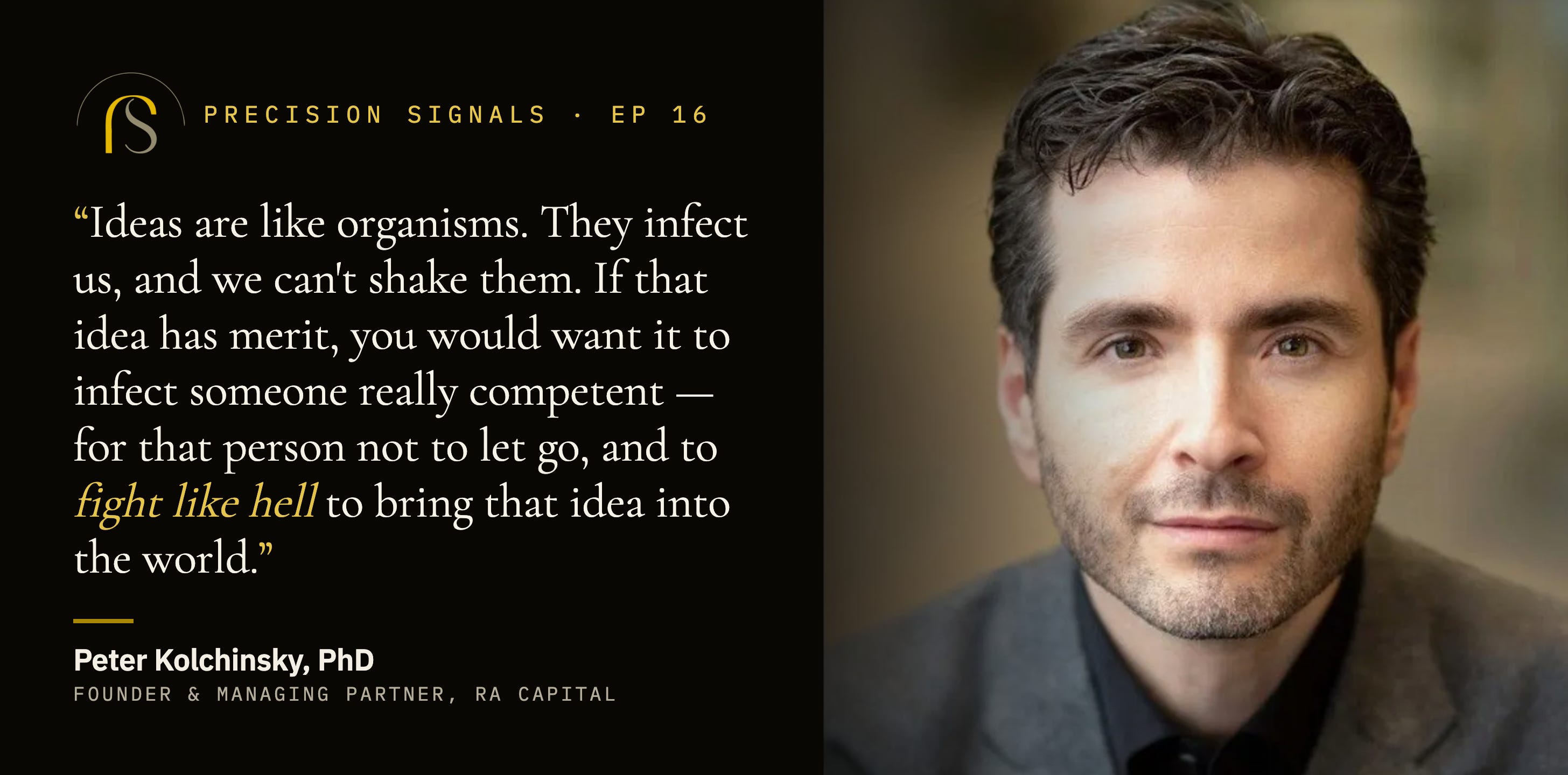
Some ideas arrive quietly. Others behave more like organisms. They take hold of someone, grow, and demand to be brought into the world.
The challenge is knowing which ideas deserve that kind of commitment.
In the latest episode of Precision Signals, I spoke with Peter Kolchinsky, PhD, founder and managing partner of RA Capital Management, about the people and systems that determine whether scientific ideas become medicines.
Peter’s own story begins with his parents, Soviet Jewish immigrants who came to the United States with deep faith in education, hard work, and the possibility of progress. His father was a mathematician and computer engineer who eventually started his own company. His mother trained as a mathematician, became a computer programmer, and later reinvented herself as a flower designer and entrepreneur.
From them, Peter inherited two instincts that have shaped his career: the confidence to become excellent at something and the willingness to change direction when circumstances demand it.
He initially pursued science, studying biology, conducting virology research, and earning a PhD from Harvard. But he came to recognize that his greatest contribution might not be making one breakthrough discovery himself. It might be helping other scientists turn their discoveries into medicines.
That realization led him to launch the Harvard Biotech Club, write The Entrepreneur’s Guide to a Biotech Startup at just 23, and eventually build RA Capital into one of the leading biotechnology investment firms.
Peter’s career offers a useful framework for thinking about progress in biotech. Breakthroughs do not happen in isolation. They depend on the quality of the institutions around them, the speed of the learning loops, and the willingness of leaders to engage with difficult realities.
The value of institutional memory
One of the most important themes in our conversation was the importance of remembering what the field has already learned.
Biotech is full of failure. Molecules fail. Companies fail. Clinical trials fail. Strategies that once looked promising become obsolete.
The natural response is to move on and start again. But if the lessons from those failures are not captured, the industry repeatedly pays to learn the same things.
Peter described RA Capital’s effort to build an institutional knowledge engine that maps scientific fields, competitive landscapes, emerging technologies, and failed experiments. The goal is to build an organization that becomes more intelligent with time.
The advantage of an institution is not simply that it has more information. It is that it can preserve context. What was known when a decision was made? Which assumptions proved wrong? What did the field learn from the programs that failed?
In drug development, that accumulated knowledge can be the difference between pursuing a genuinely differentiated opportunity and repeating a familiar mistake.
AI is not the same as progress
The conversation also turned to artificial intelligence and its role in drug development.
There is no question that AI has achieved remarkable engineering successes. Tools such as AlphaFold and RFdiffusion have demonstrated what is possible when sophisticated models are applied to complex biological problems.
But designing a molecule is not the same as demonstrating that it will work in people.
As Peter pointed out, drug development has one of the slowest learning loops to which AI could be applied. A company may generate a promising molecule quickly, but it can take years and many clinical programs to determine whether the technology is producing a meaningful improvement.
That creates a challenge for evaluating AI companies. If a company claims to improve the success rate of drug candidates, how many programs need to reach the clinic before that claim becomes credible? Five? Ten? Twenty-five?
The answer cannot be determined by a compelling demonstration or an attractive model output. It requires evidence generated through the long, expensive, and unforgiving process of clinical development.
This does not diminish the promise of AI. It clarifies where the promise must be tested.
The infrastructure behind innovation
Peter also offered a provocative view on China’s biotechnology ecosystem.
The discussion was not simply about scientific competition or geopolitics. It was about infrastructure.
Over the past decade, and particularly in the last five years, China has built out clinical trial capacity, medical centers, and systems capable of aggregating patient data at significant scale. That infrastructure can make it easier to identify eligible patients, enroll studies, and generate proof-of-concept data.
In Peter’s view, this may have a greater near-term effect on the pace of biomedical R&D than AI.
That observation is easy to overlook because infrastructure is less visible than a new model or platform. But clinical trial enrollment is one of the most important constraints in drug development. AI can help generate hypotheses. It cannot, by itself, enroll patients or produce clinical evidence.
The broader lesson is that innovation depends on more than discovery technology. It depends on the systems that allow ideas to be tested.
The FDA as a living institution
Peter’s perspective on the FDA has also evolved.
Early in his career, he saw the agency as a monolithic gatekeeper that could determine whether a company succeeded or failed. Over time, through direct engagement with people inside the agency, he came to see it differently.
The FDA is an institution, but it is also made up of individuals trying to make difficult decisions within a complex system.
That does not mean the agency is free from problems. Institutions can become slow, opaque, and resistant to change. They can also behave in ways that differ from the intentions of the people within them.
But treating the FDA as an unknowable force makes constructive engagement impossible.
A better approach is to build relationships, understand the reasoning behind decisions, and recognize that regulatory progress requires communication at scale.
Leadership is not a job description
Toward the end of our discussion, Peter made a distinction that stayed with me.
Many CEOs, he argued, function more like project managers than leaders. They oversee plans, manage teams, and execute against an established set of responsibilities. But leadership requires something more.
A leader should be a thought leader. Someone who understands how the field is changing, operates at the frontier of knowledge, and is willing to act when the mission demands it.
That may include doing things that are not technically part of the job description. It may mean engaging in policy debates, advocating for patients, or challenging assumptions that have become embedded in the system.
In biotech, the mission is not simply to build a company or advance a program. It is to improve the lives of patients by bringing better medicines into the world.
That mission requires scientific judgment. It requires institutional discipline. It requires the humility to learn from failure. And it requires leaders who are willing to define their role by what must be done, not by what is considered normal for their title.
The signal beneath the noise is often found in the systems, people, and decisions that determine whether progress can actually happen. That’s why I found the conversation with Peter so valuable and informative.