


In June 1998, Brian Druker, an oncologist and physician-scientist at Oregon Health & Science University who helped lead the development of imatinib, walked into a hospital room in Portland every thirty minutes to see whether his first patient was still all right.
The patient was a retired railroad engineer from the Oregon coast. Two years earlier, after reading Druker’s first paper on a promising leukemia compound, he had written to volunteer as the first subject. Now he was receiving the drug in a phase I trial. Every time Druker appeared at the door, the man answered in the same raspy voice: “Still here, doc. I’m okay.”
Druker was not hovering because the preclinical data had warned him to. He was hovering because of another patient years earlier.
She had colon cancer. Druker had enrolled her in a phase I trial of Taxol at close to the maximally tolerated dose. The drug caused severe diarrhea and put her in the hospital for weeks. Her tumor did not respond, and the patient’s family suggested that Druker had given them false hope. He worried they may be right.
He carried that patient into the room in Portland. What if the new drug did nothing? What if it was toxic? What if, again, the treatment caused more harm than the disease?
The engineer’s first dose was too low. Nothing happened. Druker brought him back in April 1999 at a higher dose. This time he responded, and he lived for many more years.
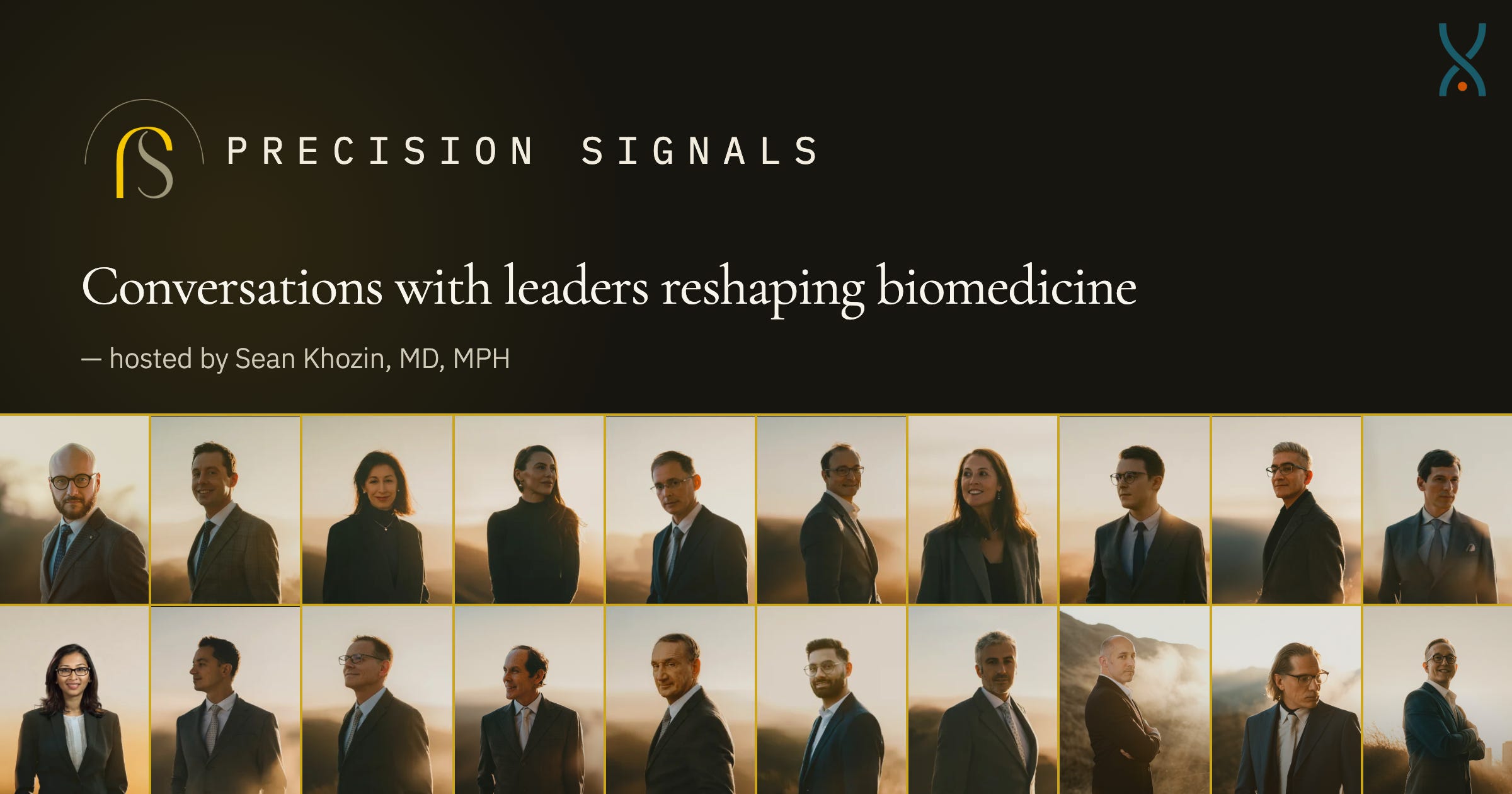
The landmark paper tells the story differently. At doses of 300 milligrams or more, 53 of 54 patients had their blood counts return to normal. The paper contains only the results, as it should, but not the full story: the hopes, challenges, and fears in the exam rooms and hospital wards. That erased context is where the real lessons live. That gap is why we created Precision Signals.
The published record of any major scientific advance often resembles a compression algorithm. It preserves the endpoint and discards much of what produced it: the wrong turn that opened the right path, the institutional obstacle that forced a better design, the patient who made a scientist cautious, the argument inside a regulatory agency, the capital structure that determined how long a program was allowed to fail.
One year into these conversations, the founding question has become more urgent. Biomedical information is multiplying faster than our ability to interpret it. The constraint is no longer simply producing more data. It is recognizing which data matter, what they mean, and what must happen next.
I. The seduction of a clean signal
Imatinib, later marketed as Gleevec, is one of the cleanest stories in modern medicine. It is also much messier than the version most people know.
In late 1992, Druker had spent four or five years at Dana-Farber. He had roughly twenty publications but only a few as first author. When he asked to establish his own laboratory, they looked at his record and told him his work did not seem to be going anywhere. The rejection devastated him. It also sent him to Oregon, where he could reestablish a relationship with Ciba-Geigy that had ended for his laboratory in Boston. He called Nick Lydon, the Ciba-Geigy scientist leading the company’s kinase-inhibitor work, and asked whether Ciba had compounds that inhibited ABL. Half a dozen arrived in Oregon, blinded and largely unprofiled. Three months later, one stood out: it killed chronic myeloid leukemia cells while sparing normal cells. That was late 1993.
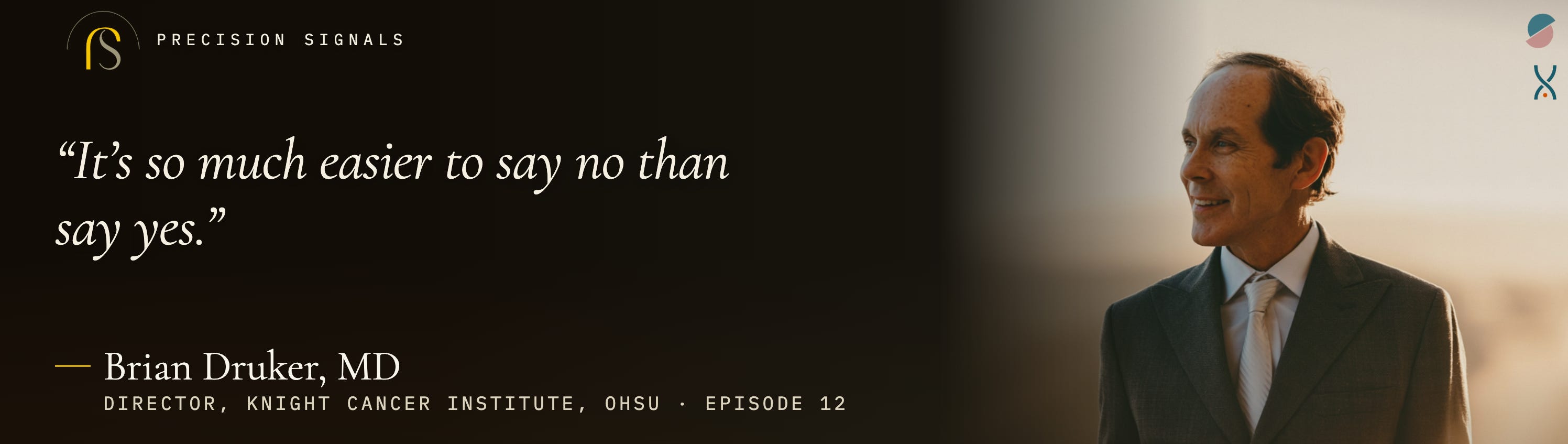
The proposition still sounded implausible to many scientists. Biochemists doubted that an ATP-competitive inhibitor could reach a useful concentration. Oncologists doubted that a single agent could control cancer. Druker distilled the resistance into a sentence that travels well beyond medicine:
“It’s so much easier to say no than say yes.
But chronic myeloid leukemia had offered an unusually legible target. In 1960, University of Pennsylvania pathologist Peter Nowell and cytogeneticist David Hungerford identified an abnormal chromosome in CML cells. In 1973, University of Chicago cytogeneticist Janet Rowley showed that it resulted from a translocation between chromosomes 9 and 22. The rearrangement creates the BCR-ABL1 fusion gene, which encodes a constitutively active kinase that drives the disease. Druker discovered that imatinib turns that signal off.
That biological clarity shaped the trial. Druker joined leukemia specialist Moshe Talpaz at MD Anderson and oncologist-scientist Charles Sawyers at UCLA to enroll patients with CML, not a broad assortment of advanced cancers, because that was where an ABL inhibitor had a rational chance to work. They chose patients whose disease was resistant to interferon but still in the chronic phase, giving the drug enough time to reveal an effect.
The effect was extraordinary. A disease that once carried a typical life expectancy of three to five years became, for many patients, a long-term manageable condition. In the first randomized trial of newly diagnosed patients, the estimated 10-year overall survival was 83.3%. Some people from Druker’s earliest trials were still under his care twenty-six years later, and when we published our conversation, several of them found the post and shared their gratitude:
“Dr Druker is responsible for my 80th birthday next week. 26 years ago I only had a few more months to live.”
“Dr. Druker is responsible for the last 12 years of my life. Thank you so much sir. He is a real life superhero.”
“My super héros to. Thank you for saving my life dr Druker”
It is tempting to turn that triumph into a general formula: find the driver, build the inhibitor, select the patient, watch the disease recede. Much of precision oncology was built on that hope. Unfortunately, most cancers have not cooperated. Their biology is polygenic, heterogeneous, and adaptive, and our existing disease models capture only part of the system. Responses that appear decisive can be temporary, and acquired resistance to even the most potent targeted therapies today is not an exception to the treatment story; it is often the next chapter.
So the enduring lesson of imatinib is that progress accelerates when the problem has been made legible, biologically, clinically, and institutionally, and stalls when one of those forms of legibility is missing.
That distinction is why failed programs all look alike from a distance. A molecule aimed at the wrong target, a drug optimized in the wrong model, a trial built around the wrong endpoint, a technology that cannot survive a hospital workflow, and a program killed by its financing all end with the same decision: stop.
They are not the same failure. They do not teach the same lesson
II. When the signal moves
James Gulley, Chief of the Medical Oncology Service and Co-Director of the Center for Immuno-Oncology at the National Cancer Institute, was a pioneer in immuno-oncology long before the field was in vogue. Having had the privilege of working closely with him during my time at the NCI, and later across multiple projects during my tenure at the FDA, I saw firsthand how his work pierces through the fundamentals. Our collaborations spanned from the early days of immunotherapy development to more recent efforts integrating AI into the fabric of clinical research, designing adaptive clinical trials, and reimagining real-time data capture.
At every inflection point, Gulley has brought a distinctive perspective that bridges mechanistic insight with operational execution. Once it became clear that the immune system could produce durable tumor control, a harder set of questions emerged. Why does the same antibody transform one patient’s course and do nothing for another? Why have predictive biomarkers remained so unreliable? And what does resistance actually mean when a treatment acts not on the tumor itself, but through an adaptive immune system?
Even measurement becomes unstable. Conventional oncology trials observe patients at scheduled intervals, compressing continuous biology into a few visits, scans, and laboratory values. A small prospective pilot study in multiple myeloma showed what may be hidden between those snapshots: among 25 evaluable patients receiving CAR-T therapy, a wearable model detected 18 of 20 episodes of cytokine release syndrome, with a median lead time of seven hours before standard nursing recognition.
Indeed, the time of a clinical event depends on the instrument used to observe it. Change the instrument, and the event itself appears to change. This principle extends beyond physiological vitals into the subjective experience of cancer itself. Gulley’s recent work explores using machine learning to quantify pain and affect through facial recognition and voice audio waves, aiming to detect the onset of a pain crisis long before a patient self-reports it on a standard 11-point scale. When the tools of scientific inquiry become continuous and increasingly autonomous, they don’t just capture data differently; they redefine the clinical reality we are able to treat.
Of course, challenges and uncertainties do not disappear when immunotherapy works. It moves into the thyroid, the heart, the nervous system, and other organs that were never the intended target. Afreen Shariff is the endocrinologist who directs Duke’s Onco-Endocrinology Program and sees such patients. Jon McDunn is a biomedical scientist and president of the cancer-research nonprofit Project Data Sphere. In our conversation on immune-related adverse events, another form of compression was exposed. A trial report can name a toxicity and assign it a grade. A clinician facing a symptomatic patient needs to know which clue matters, who should see the patient, and how quickly. Shariff has built an e-consult model around the two gaps she sees most often: expert triage and access to that expertise.
In our conversation on Precision Signals, Sushil Patel, chief executive of the cancer-therapy company Replimune, reflected on the future of immuno-oncology and the fraught regulatory path of their lead asset. We spoke during a critical window of uncertainty: after the FDA issued a complete response letter in July 2025, but before a second one arrived in April 2026.
The core of the dispute centered on what a single-arm study could actually prove. The FDA’s April letter argued that the application could not isolate the drug’s contribution when combined with nivolumab, raising concerns about the study population and response assessment. Replimune countered that the observed responses were durable and clinically meaningful for patients who had run out of alternatives.
Then, the narrative shifted rapidly. The FDA accepted a resubmission in June. On July 30, an advisory committee voted 10 to 3 that the IGNYTE trial results were indeed evaluable and clinically meaningful. Just a week later, on August 6, the agency granted accelerated approval to Tudriqev with nivolumab for adults with unresectable advanced cutaneous melanoma whose disease had progressed on a PD-1-based regimen.
The data told a complex story. IGNYTE enrolled 140 patients. For the 91 patients with at least one non-injected lesion—the efficacy-evaluable population used for approval; the objective response rate was 24.2%, and the median duration of response was 14.1 months. Continued approval now depends on confirming clinical benefit in the ongoing randomized phase 3 IGNYTE-3 trial.
The important point here is not that one side was right all along. It is that the exact same development program can support sharply different judgments about bias, attribution, urgency, and acceptable uncertainty.

III. Machines relocating uncertainty
Olivier Elemento directs Weill Cornell Medicine’s Englander Institute for Precision Medicine; oncologist Cora Sternberg is its clinical director. In the inaugural episode, we discussed why so many medical AI tools perform well in retrospective studies and so few earn a durable place in clinical practice.
The distance between technical validation and adoption is not explained by clinician skepticism alone. Trust has to be built in the setting where the tool will be used, against a relevant comparison, with an outcome a clinician can recognize. Data access, workflow, prospective testing, reimbursement, and accountability often determine more than the model architecture does.
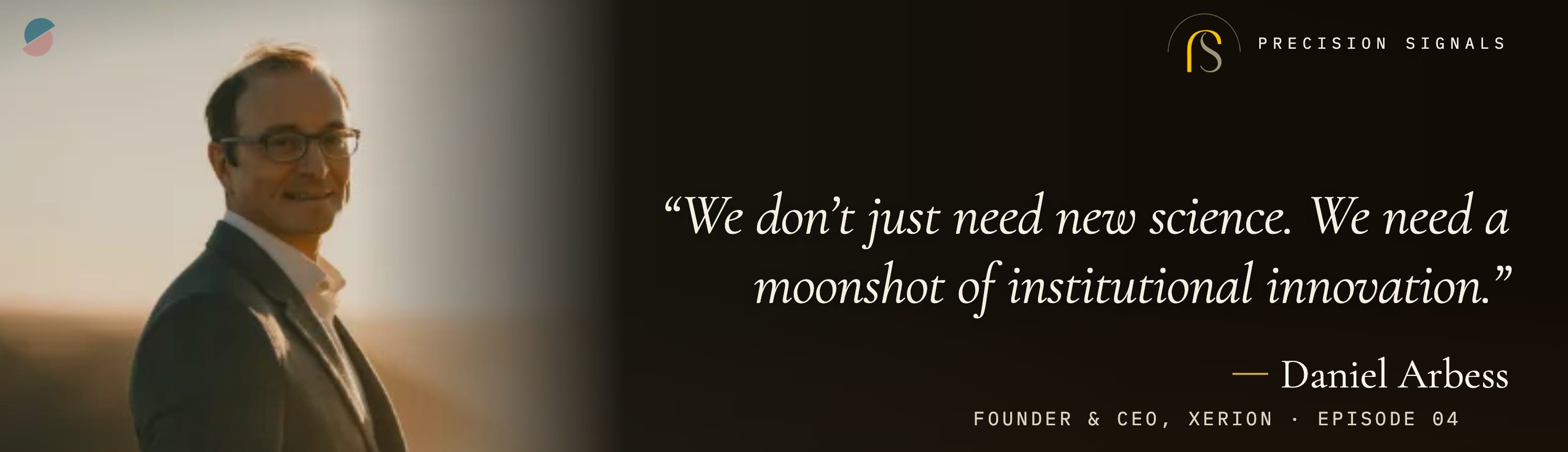
In her episode of Precision Signals, Michelle Longmire, a physician-scientist who co-founded and leads the clinical-trial technology company Medable, described encountering this exact bottleneck from the operational side: biology is advancing far faster than the apparatus built to test it. Study startup is painfully slow, sites are scarce, data remains fragmented, and participation is often punishing for patients. At Medable, she set a deliberately destabilizing target known as the 1:1:1 model: one day to start a study, one day to enroll a participant, and one year to complete it. A goal inside the existing framework invites incremental optimization. A goal outside of it forces the entire model to be questioned.
Thomas Clozel, an oncologist who co-founded and leads the biomedical AI company Owkin, left clinical practice because biology, as he put it, had become too complicated for the unaided human mind. That realization led Owkin to build systems designed to learn across institutions without requiring patient-level data to ever leave them.
What that kind of computation can reveal is perfectly illustrated by MesoNet. Trained on nearly 3,000 digitized pathology slides from the French MESOBANK collection and independently validated on a cohort from The Cancer Genome Atlas, the model predicted survival in malignant mesothelioma more accurately than conventional histology. But the most striking finding was not its accuracy; it was its focus. The regions carrying the strongest prognostic signal were located primarily in the stroma (areas characterized by inflammation, cellular diversity, and vacuolization) rather than in the malignant cells themselves.
For generations, pathologists were trained to focus their attention on malignant cells. The model had no such inherited bias. It found a vital pattern in the tissue that the human eye had learned to look right past.
That is the profound promise of computation in medicine, and also its inherent discomfort. A model can discover a signal without possessing the conceptual vocabulary that makes it intelligible. It can tell us exactly where to look before we understand why looking there matters. The machine has not eliminated uncertainty—it has simply handed the uncertainty back to us in a much more interesting form.
David Fajgenbaum, a physician-scientist at the University of Pennsylvania and co-founder of the drug-repurposing nonprofit Every Cure, reached computation through a different route: his own near-death, using data architecture to save his own life.
As a third-year medical student, he developed idiopathic multicentric Castleman disease and suffered repeated episodes of multiorgan failure, nearly dying five times. With no reliable roadmap, he banked and analyzed his own blood across relapse and recovery. The data implicated the mTOR pathway and led him to sirolimus, an immunosuppressant used in transplantation that had never been used for his disease. He has now been in remission for more than a decade.
He could have treated that outcome as a miracle of individual persistence. Instead, he treated it as a systems problem. He co-founded Every Cure on the premise that useful therapies may already exist, separated from the patients who need them by the way biomedical knowledge is organized.
Its MATRIX project attempts to score approved drugs against human diseases at scale. ARPA-H now lists an award of up to $124 million for the program, with a second phase intended to advance at least 30 repurposing opportunities into preclinical or clinical validation.
Druker arrived at the same principle by accident. After imatinib’s approval, a dermatologist in Utah called to ask about trying a quarter-dose in patients with hypereosinophilic syndrome. Druker thought the idea was implausible. The disease “melted away.” Only later did researchers identify a PDGF-receptor rearrangement that explained why those patients were exquisitely sensitive to the drug.
The empiricism came first. The mechanism caught up.
IV. What survives is a design choice
The CEO Roundtable on Cancer began with a fundamental judgment about institutions. In 2001, President George H.W. Bush asked Robert A. Ingram, then chief executive of GlaxoWellcome, to convene leaders from business, government, academia, and the nonprofit sector to do something “bold and venturesome” about cancer. That challenge led to the CEO Cancer Gold Standard and, eventually, to Project Data Sphere, an open-data and AI model development organization launched in 2014.
The core premise behind these initiatives was that structures determine behavior. If an existing system cannot produce the needed behavior, exhortation is not enough. The structure itself has to change.
That idea recurred continuously throughout the first year of Precision Signals. We saw it in how evidence is disseminated, how discovery is incentivized, and how capital is deployed.
Consider the architecture of medical consensus. Clifford Hudis, an oncologist and the chief executive of the American Society of Clinical Oncology (ASCO), explained how ASCO had to structurally adapt to clinical evidence that now evolves faster than traditional publishing cycles. In 2022, the organization launched living guidelines for stage IV non-small-cell lung cancer, maintained by standing expert panels and updated continuously as practice-changing data emerge, ensuring that bureaucratic lag does not delay patient care.
In the same way that ASCO is redesigning the flow of evidence, others are redesigning the flow of discovery and capital. Karen Knudsen, a cancer biologist and chief executive of the Parker Institute for Cancer Immunotherapy, detailed how the organization was built on a novel intellectual-property model designed to seamlessly push discoveries between academic centers, nonprofits, and industry. The system assumes ambitious science will frequently fail, but it rewards collaboration over silos and recycles its returns into new research.
Similarly, Dan McHugh, an investor at the oncology investment firm Yosemite, broke down how the structure of capital dictates the clock of innovation. Yosemite combines conventional venture equity with grant capital that does not take IP. Because these two pools of money tolerate different forms of uncertainty and carry different timelines, they change the fundamental math of drug development, dictating how much evidence a program must produce, how quickly it must produce it, and which failures it is allowed to survive.
Yet, every structural choice ultimately lands on a human being. Sunil Verma, AstraZeneca’s global head of oncology, brought the argument back to the exam room. Molecular profiling may identify the exact therapy matched to a tumor, but it cannot decide the risks a person is willing to bear, the physical function they most want to preserve, or what they need to be able to do a year from now. Precision is molecular. Personalization is human.
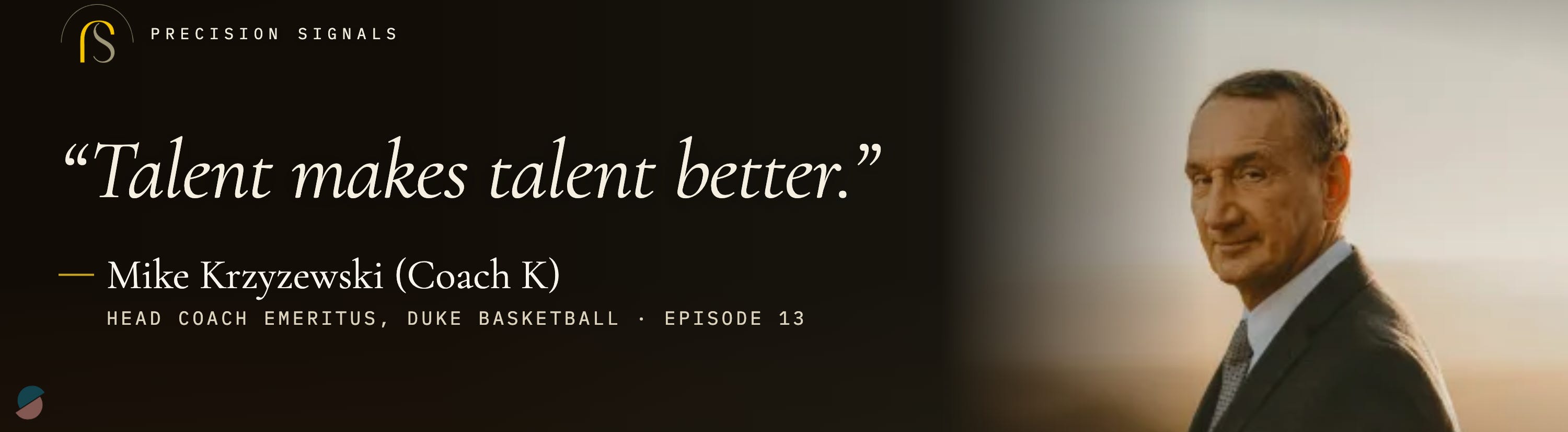
Mike Krzyzewski (Coach K), the legendary Duke men’s basketball coach, understood that distinction long before he had the clinical language for it. His father operated an elevator at Willoughby Tower in Chicago; his mother cleaned floors at the Chicago Athletic Club at night. What they gave him, he noted on the podcast, was not wealth, but the certainty that someone stood behind him. He never had to believe that failure would leave him alone.
When the conversation naturally shifted to teams, his philosophy translated perfectly to biomedicine. A care team is not just the physician and the nurse. It is the technician, the trial coordinator, and the person who cleans the room. A functioning team makes every contribution visible and every person an owner of the outcome. “Talent,” he reminded us, “makes talent better.”
Coach K then shared the story of Jim Valvano, the former North Carolina State basketball coach who transitioned from his greatest rival to his closest friend. While visiting Valvano during the final months of his life, Krzyzewski remembered Valvano learning a staggering statistic: only one in six cancer researchers seeking support actually received funding. Valvano’s response wasn’t statistical; it was desperately human: What if one of the other five had the cure for his cancer?
The V Foundation, created by Valvano and ESPN in 1993, has since awarded nearly $458 million in cancer research grants, using an endowment to cover administrative expenses so that 100 percent of direct donations fund the science.
Valvano’s question gets to the heart of the matter. The unfunded five are not a metaphor. They are the human consequence of a selection system. Capital sits upstream of experiments, experiments sit upstream of evidence, and evidence sits upstream of patients. The tolerance for risk built into the very first decision eventually, inevitably, appears in the last.
V. Following the signal
Biology, technology, evidence, capital, policy, regulation, and care do not wait politely for one another. They interact continuously. A choice made in one domain silently rewrites what is possible in the next.
Imatinib reached Brian Druker because a career rejection pushed him across the country and reopened a dormant industry relationship. A wearable algorithm detected a clinical event hours before the hospital because it monitored continuously rather than periodically. A pathology model found a vital prognostic signal in the exact tissue that experts had been trained to discount. A transplant drug halted a rare inflammatory disease because a medical student became his own longitudinal study. An oncolytic virus pivoted from two FDA rejections to an accelerated approval because the data were argued over, reanalyzed, and judged under the pressure of an urgent unmet need.
This is exactly what polished, retrospective narratives tend to remove: contingency. They make progress look inevitable in hindsight. It never is.
Moving into its second year, Precision Signals will continue hunting for the moments when theory collides with reality and when persistence pushes us into new terrains of discovery. If there is a conversation we need to have, please comment below with suggestions. To follow the journey, please consider subscribing on YouTube.
The noise will only keep multiplying. The task is to find the signal and build a system capable of acting on it.