



At four in the morning, two weeks into a pain in his upper back that would not go away, Sid Sijbrandij went to an emergency department. He had first noticed the pain while bench pressing, and it had come and gone before. The physicians reassured him that there is no such thing as a two-week heart attack and sent him home. A few hours later his own doctor called with an unexpected question: did he know how to meditate? His blood pressure at the hospital had been 170. The pain might be his aorta beginning to tear. He should bring his pressure down and go back immediately.
It was not his aorta. It was a six-centimeter osteosarcoma growing out of his T5 vertebra, a rare bone cancer in a 45-year-old man who, the year before, had taken his software company, GitLab, public.
He received excellent care at a major hospital. But when standard of care ran out, he sought to learn as much as he could about his cancer to open up new options. His team jumped through substantial hoops to get the raw data behind the sequencing tests that had been ordered by his physicians and analyzed the genomics of the tumor. This identified vulnerabilities that were not called out in the standard report.
The difficulty was not simply obtaining the data, but looking beyond what the standard report had identified as actionable. That distinction exposes the limits of a principle most of us in medicine learned in training: order only what you can act on. The rule made sense when the set of possible actions was small and fixed. It becomes a constraint when what we can learn from a patient’s tumor (and do in response) outpaces the guidelines meant to govern care. Guidelines have spared many patients from guesswork, and teaching physicians to follow them was one of medicine’s real achievements. The next frontier, however, is teaching them to follow the patient.
That shift begins with seeing what guidelines rest on. A test is worth ordering if it points to a proven treatment, and a treatment is proven if it works in a trial. But trials enroll narrowly selected patients, often younger and healthier than those who will later receive the drug, and they report what happened to the group rather than to any one person in it. The patient in the clinic rarely resembles the patients in the trial, and even the patients in the trial do not resemble its average. For more than sixty years, medicine has asked a simple question: does this work? What it has actually meant is much narrower: does this work on average? And the average, it turns out, is the least precise estimate of what will happen to any one patient.
I. The myth of the average man
American drug law was written in the aftermath of tragedy. After a sulfanilamide elixir dissolved in diethylene glycol killed more than one hundred people in 1937, the Federal Food, Drug, and Cosmetic Act of 1938 required manufacturers to show that a new drug was safe. After thalidomide, which Frances Kelsey kept off the American market, the Kefauver-Harris Amendments of 1962 added a second requirement: substantial evidence of effectiveness from adequate and well-controlled investigations. Is it safe, and does it work. The randomized controlled trial became the instrument for answering the second question, and it has served patients extraordinarily well.
The second question, however, carries an assumption inherited from the nineteenth century. In 1835, the Belgian astronomer Adolphe Quetelet introduced l’homme moyen, the average man. A decade later, applying the mathematics of astronomical error to the chest measurements of 5,738 Scottish soldiers, he found the familiar bell curve and concluded that the average was the type nature intended, and that each actual person was an error around it.
More than a century later, the United States Air Force tested that idea by accident. In the early 1950s, with pilots losing control of their aircraft at alarming rates, a young researcher named Gilbert Daniels measured more than 4,000 pilots on ten body dimensions and asked how many fell near the average on all ten. None did. A cockpit designed for the average pilot fit no pilot at all. The Air Force responded by requiring adjustable seats, pedals, and straps, and the cockpit began to fit the person.
The randomized trial’s central output is also an average. A hazard ratio of 0.40 is a statement about two groups. Within a treated arm, some patients benefit enormously, some not at all, and some are harmed, and the trial combines them into a single number that describes, in a precise sense, no one in particular.
The arithmetic is unforgiving. Daniels counted a pilot as average on a dimension if he fell within the middle 30% of the range. Were the ten dimensions independent, the chance of being average on all of them would be 0.3 multiplied by itself ten times: about six in a million. In high dimensions, nearly everyone is an outlier. A tumor described by hundreds of genomic, transcriptional, and microenvironmental features is a very high-dimensional object, and the patient who carries it is almost certainly an outlier on something that matters. A clinical guideline, distilled from the average results of trials, describes the center of a distribution in which almost no one actually lives. A physician trained only to follow it is trained, in effect, to treat a hypothetical patient who doesn’t exist.
II. A stratum of one
For most of the last half century, that limitation was tolerable because nothing better was available, but it’s becoming harder to accept because the gap between what we can do in the laboratory and what we can prove in the clinic widens every year.
Let’s consider the cost of proof. An analysis of public financial filings by Olivier Wouters and colleagues estimated that bringing a new medicine to market between 2009 and 2018 required a median of $985 million and a mean of $1.3 billion in research and development, including the cost of failures, with cancer drugs among the most expensive. Industry estimates run higher. In 2012, Jack Scannell and colleagues documented what they called Eroom’s Law, Moore’s Law spelled backward: the number of new drugs approved per billion inflation-adjusted dollars of research spending had halved roughly every nine years since 1950, an 80-fold decline. In oncology, an analysis of more than 21,000 compounds by my colleague Andrew Lo’s group at MIT found that only 3.4% of programs that entered phase 1 between 2000 and 2015 reached approval.
Now let’s think about the cost of knowledge. Sequencing a human genome cost roughly $95 million in 2001 and about $525 in 2022, and the price has continued to fall. A base editor for a single child’s mutation was designed, manufactured, and administered in six months. Individualized cancer vaccines are now made for each patient, one at a time, inside a phase 3 trial. The instruments of discovery have followed something like Moore’s Law. The instruments of proof have followed Eroom’s.
The standard evidence base itself rests on a small minority of patients. About 7% of adults with cancer in the United States enroll in treatment trials. The experience of everyone else, the overwhelming majority of people who receive cancer therapy, has been largely lost to systematic learning.
Precision oncology sharpened the mismatch rather than resolving it. Stratifying patients by biomarker made each average more relevant to the people inside it, but it also made each stratum smaller, slower to enroll, and more expensive per patient to study. The fixed cost of a conventional development program doesn’t shrink with the size of the population it serves. Followed to its logical end, the strategy arrives at a stratum of one, where the economics of the population model collapse entirely, and where many therapies that science could produce are never made at all.
III. The private life of a tumor
In 1976, the pathologist Peter Nowell proposed that a cancer is not a fixed entity but an evolving population. Every cell division is an opportunity for new mutations. Every therapy is a selective pressure. The tumor that survives treatment descends from whichever cells happened to carry a way out. Nowell’s model predicted that tumors would diversify over time, and that no two would diversify in quite the same way. He drew the clinical implication himself: each patient’s cancer, he wrote, may require individual specific therapy.
Five decades later, sequencing has confirmed both predictions. When Marco Gerlinger and colleagues sampled multiple regions of individual kidney cancers, they found that roughly two-thirds of the somatic mutations in each tumor were not present in every region of that same tumor. A single biopsy simply describes a neighborhood and not the city.
Targeted therapy made this evolution visible in real time. Imatinib transformed chronic myeloid leukemia, and resistance arrived through new mutations in the very kinase it inhibited. EGFR inhibitors in lung cancer selected for the T790M mutation; the drug designed to overcome T790M selected in turn for C797S, for MET amplification, and for transformation into entirely different histologies. BRAF inhibitors in melanoma were defeated by a long catalog of ways to reactivate the same signaling pathway. The pattern is general. The more precisely a drug strikes a single dependency, the more strongly it selects for cells that no longer need it, and the route of escape can differ from one patient to the next.
KRAS is the most recent and perhaps the most instructive example. For four decades it was the protein oncology could describe but not touch. Mutated in roughly one in five human cancers, it offered a nearly featureless surface to medicinal chemists, and its mutant forms held their activating molecule, GTP, with picomolar affinity. The word most often attached to it was undruggable.
In 2026 the protein finally yielded, and from two directions at once. The first was precision. In Nature Medicine, the oral KRAS G12D inhibitor GFH375 produced a 35.1% response rate in heavily pretreated pancreatic cancer, and HRS-4642, an intravenous liposomal G12D inhibitor, combined with chemotherapy produced responses in 63.3% of 30 untreated patients. The second was breadth. Daraxonrasib, which blocks the active form of RAS across mutant and wild-type variants, nearly doubled median overall survival in a randomized phase 3 trial in previously treated metastatic pancreatic cancer, from 6.7 to 13.2 months, and in August became the first RAS inhibitor approved by the FDA for the disease.
Nowell would have recognized what came next. The median duration of response to GFH375 was 5.6 months. When Mark Awad and colleagues at Dana-Farber examined patients whose cancers had escaped the KRAS G12C inhibitor adagrasib, they found secondary mutations in KRAS itself, bypass alterations in MET, NRAS, BRAF, and other genes, and in some lung cancers a change of identity from adenocarcinoma to squamous carcinoma. Several patients carried more than one escape mechanism at the same time. In October, a study of 242 patient-derived pancreatic cancer organoids identified a subset resistant from the outset to allele-specific and broad KRAS inhibitors alike, distinguished by silenced interferon signaling.
The lesson extends well beyond KRAS. A response rate tells us that a drug can open the gate. It cannot tell us which escape route a particular tumor will take, or when. That knowledge exists only at the level of the individual patient, and it changes over weeks.
IV. A medicine made for one
In February 2025, in a room at the Children’s Hospital of Philadelphia, an infant named KJ Muldoon received an intravenous infusion of a drug that had never been given to anyone else, and never will be. KJ was born with severe CPS1 deficiency, which left his liver unable to clear ammonia from his blood. A team led by Rebecca Ahrens-Nicklas and Kiran Musunuru developed a medicine designed around one of his two mutations: a guide RNA composed for that single sequence, a messenger RNA encoding a base editor, and a lipid shell to carry both into his liver. From diagnosis to first dose took about six months. The FDA cleared the application in about a week.
There was no control arm. There was no population. The number of patients in the study, then and forever, was one. KJ’s infusion was the most vivid point on a curve that has been bending for several years.
Months after KJ’s treatment, Vinay Prasad, former director of the FDA’s Center for Biologics Evaluation and Research, and former FDA Commissioner Marty Makary described what they called a plausible mechanism pathway. A bespoke therapy could reach the market without a randomized trial if it targeted a known molecular cause, if engagement of that target was confirmed, and if clinical improvement was observed across several consecutive patients, each serving where appropriate as their own control. They wrote with rare genetic disease in mind, but noted that the principles could extend to other drugs over time.
In oncology, the curve bent further this year. In the phase 3 INTerpath-001 trial, intismeran autogene, an mRNA therapy designed from the mutations in each patient’s own melanoma, reduced the risk of recurrence or death by 42% when added to pembrolizumab. Every patient in the experimental arm received a different molecule. What the trial validated was not just a product but a process: a way of reading a tumor and writing a medicine in response. Seven years earlier, the I-PREDICT study led by Jason Sicklick and Razelle Kurzrock had pointed the same way, finding that patients whose drug combinations more closely matched their tumors’ molecular profiles fared better.
The plausible mechanism pathway is a genuine advance, but it still carries a trace of Quetelet. It asks that a bespoke therapy act through a mechanism that generalizes, if only across a small group of patients who share a disease and its molecular cause. In cancer, that assumption gives way quickly. Two tumors with the same driver mutation diverge in their clonal architecture, their microenvironment, and their routes of escape, and the mechanism that decides the outcome in one patient may be irrelevant in the next. Here the N of 1 is not a degenerate case of a population. It is the unit of generalization. What carries from one patient to the next is not a molecule, and often not a single mechanism, but a method: the way a tumor is read, the way a therapy is designed in response, and the way its effect is measured and acted upon. A development system built on that insight would validate the method and let each patient supply the particulars.
Others have had to build that process themselves. The diagnosis Sid Sijbrandij received after his night in the emergency department set him on the standard path: surgery, radiation, and chemotherapy, with an estimated five-year survival of roughly 30%. I spoke with Sid, and with Jacob Stern, a geneticist and former 10x Genomics product leader who now leads the scientific enterprise behind Sid’s care, for a forthcoming episode of Precision Signals. What they described is the closest thing I have seen to individualized medicine practiced as a continuous loop of measurement and decision.
During that first course of treatment, a friend from his Y Combinator cohort, whose company was developing a cancer drug built on click chemistry, arranged for Sid to receive it through a single-patient investigational new drug application. The experience, Sid said, showed him that more was possible than the hospital and the trials. The lesson mattered in June 2024, when the cancer returned. His oncologist had no drug to recommend, and he qualified for no trial. He described himself as “default dead” and concluded that to survive he would “have to live in the future.”
Living in the future meant measuring everything: whole-genome and single-cell sequencing at each recurrence, organoids grown from his tumor, spatial transcriptomics, serial circulating tumor DNA, and experimental imaging agents wherever they existed. It meant combining therapies rather than queuing them; in the summer of 2024 he received five immunotherapies at once. It meant five single-patient applications to the FDA, personalized vaccines, and a radioligand aimed at fibroblast activation protein, chosen in part because his RNA sequencing data had flagged it. Jacob described the tumor as having built walls, an immunosuppressive microenvironment organized around cancer-associated fibroblasts. Longitudinal single-cell and spatial data from two biopsies and the final resection suggested that the radioligand brought those walls down and let tumor-reactive T cells through. The residual tumor was excised in April 2025, and the team has not found the cancer since.
One episode captures that loop better than any diagram. The team was developing a CAR-T therapy against B7-H3, a protein on Sid’s tumor cells. To learn where else the target lived in his body, he traveled to Beijing for an experimental B7-H3 imaging scan. The scan found no cancer, but his liver lit up about two and a half times more intensely than in the twenty patients scanned before him, a warning that the engineered cells might attack it. The therapy’s designer responded with a logic gate: the cells would act only when they also encountered fibroblast activation protein, abundant in Sid’s tumor and nearly absent from the liver. A single measurement, in a single patient, redesigned a therapy before it was ever given.
The economics have moved as well. When first exploring making a personalized mRNA vaccine, the total cost of piecing together manufacturing and components would have mounted into the millions; a company Sid and Jacob later helped start can now make such vaccines at roughly a tenth of that cost. And true to the ethos that built GitLab, Sid has published the complete record, roughly 37 terabytes of genomic, imaging, and pathology data, at osteosarc.com.
Jacob was careful about what this proves. Causation cannot be established in an N of 1, and Sid’s resources make his path difficult to reproduce. But the case demonstrates something the population model was not built to see: what care looks like when the loop between observation and action is short, dense with data, and free to follow the tumor wherever it goes.
V. The L=loop
We have tended to locate precision in the molecule. A KRAS G12D inhibitor is called precise because it binds one allele; a pan-RAS inhibitor is called broad because it binds many. But the cases above suggest that precision is better understood as a property of the system in which a molecule is used, and that this property has at least three components:
• Specificity: how narrowly an intervention matches the biology of the tumor.
• Resolution: how much of the tumor’s state we can see, in depth (single-cell, spatial, circulating DNA) and in breadth (across lesions and through time).
• Tempo: how quickly we can act on what we see, relative to how quickly the tumor changes.
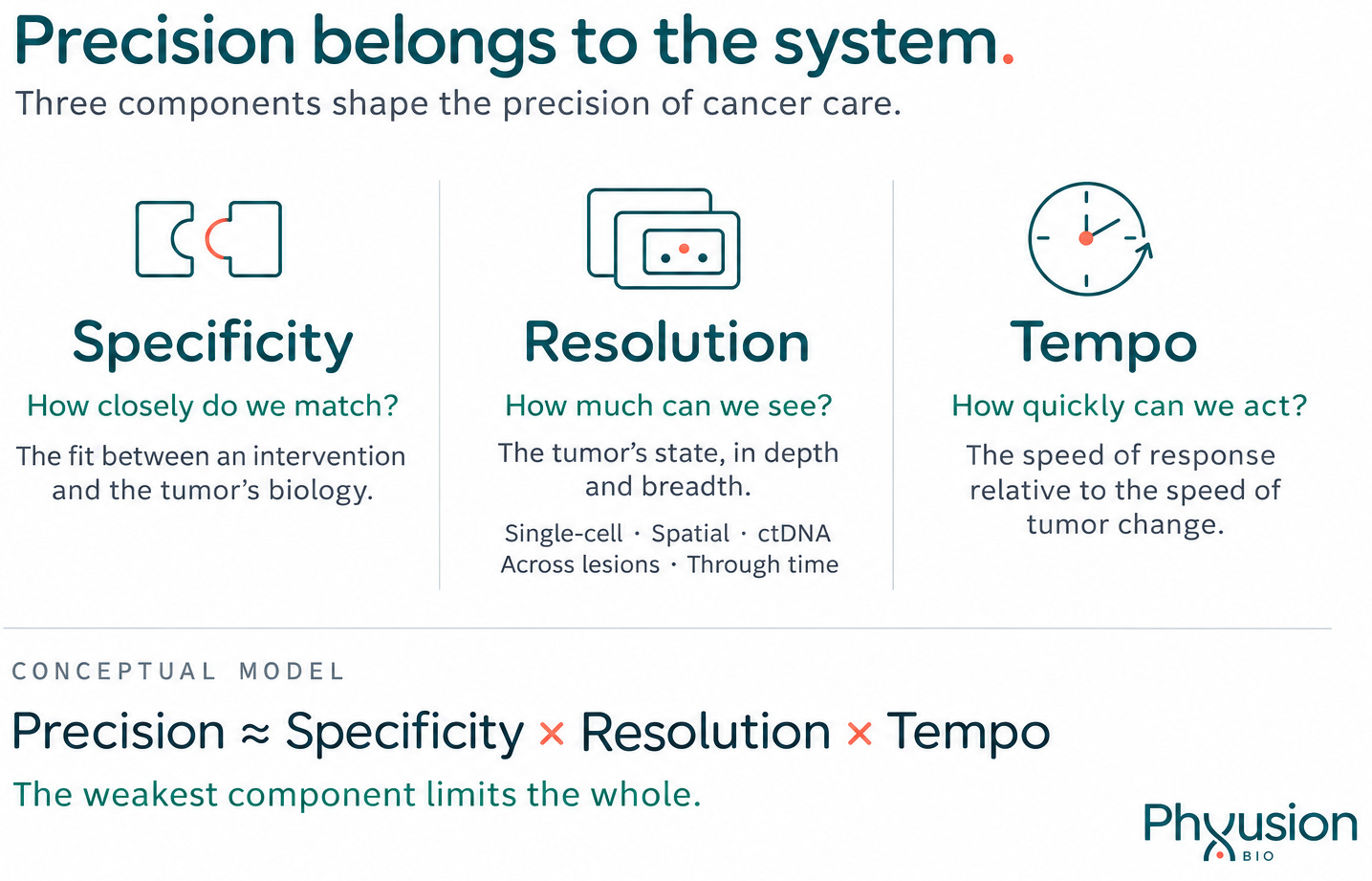
The precision of care behaves less like the sum of these terms than like their product, and the weakest one limits the whole. A highly selective drug given on a fixed schedule, with scans every eight weeks and a change of course only after a tumor has visibly grown, combines exquisite specificity with poor resolution and slow tempo. It selects for resistant clones that remain invisible until they dominate. A broad drug adjusted against frequent molecular and imaging readouts can, paradoxically, deliver more individualized care than a narrow one used statically.
Each term exacts its own price. Specificity buys tolerability and the freedom to combine, at the cost of stronger selective pressure and smaller markets. Resolution buys early warning and new targets, at the cost of money, noise, and the labor of interpretation. Tempo buys adaptation before resistance consolidates, at the cost of causal clarity and regulatory friction.

Seen this way, the long argument between precision and breadth dissolves into something more tractable. The case for breadth is a hedge against low resolution and slow tempo: if escape cannot be seen coming, suppress every route at once. The case for the N of 1 is a bet that resolution and tempo can be raised so far that specificity becomes an asset rather than a liability. Both positions are rational. They disagree about the loop, and the loop is the one thing the current development system neither measures nor regulates.
VI. The witnesses
In 1962, the only reliable witness to a drug’s effect was the control arm. Clinical records were handwritten, outcomes were recorded inconsistently, and a patient treated outside a trial disappeared from the evidentiary record the moment she left the clinic. Requiring randomization before approval was, among other things, a recognition that the clinic could not testify.
That is no longer true, and the change has happened quietly.
The tumor itself can now be interrogated repeatedly. Circulating tumor DNA reports on tumor burden and emerging resistance alleles from a blood draw, at intervals of weeks rather than months. Single-cell and spatial methods, which a few years ago belonged to research laboratories, have entered the care of individual patients. Quantitative imaging can measure the growth kinetics of each lesion, rather than reducing a scan to a single category of response.
The record has also become more interpretable. Large language models can now read unstructured clinical notes and extract endpoints that once required teams of trained abstractors. Researchers at Flatiron Health reported that model-extracted progression events across 14 cancer types approached the accuracy of expert human abstraction and yielded nearly identical estimates of real-world progression-free survival. Ambient documentation, which drafts the clinical note from the conversation itself, is capturing reasoning and symptoms that previously went unwritten.
And the past has become available as a comparator. Repositories of historical clinical trial data, including control arms, allow an individual trajectory to be placed against what similar patients experienced on standard therapy.
Patients have begun to keep the record themselves. When Jacob Stern first met Sid, Sid sent him a shared folder of some 2,500 documents and a running file of notes from conversations with clinicians and scientists that had already reached 700 pages. That archive is an example of what every patient’s course could leave behind if it were captured by design rather than by personal determination.
This points to a different idea of how medicine learns. For nearly two decades, the learning health system, a phrase popularized by an Institute of Medicine roundtable in 2007, has been imagined as an infrastructure problem: connect every clinic through electronic health records, aggregate the data, and let insight rise from the database. The records were built, at a cost of billions of dollars, but they were designed for billing and documentation rather than discovery, and a 2016 time-and-motion study found that physicians spent nearly two hours on the record and desk work for every hour of direct clinical time with patients. The learning that was promised has been disappointing at best. The N of 1 suggests a different anchor. The unit that joins observation, decision, and outcome is not the database. It is the treating clinician, who orders the measurement, interprets it, chooses the therapy, and sees what happens next. Bring research to that point of care, equip the clinician to measure and record as an investigator would, and the learning health system stops being an aspiration about data and becomes a description of practice.
The first generation of real-world evidence promised much and delivered less, largely because the data were sparse and the extraction manual. The second generation will be different in kind. A patient treated outside a trial no longer needs to be a lost observation. With measurements specified in advance and modern tools to read the record, every individualized course of treatment can become a precise data point.
VII. A regulator for the N of 1
Before a drug is approved, the FDA presides mainly over safety: to open a standard investigational trial, a sponsor need only show that the study will not expose patients to unreasonable risk, not that the drug works. The same logic governs expanded access, the pathway a physician uses to request an unapproved drug for a single patient outside a trial. There, the agency asks whether the potential benefit justifies the risk and whether better alternatives exist, and from fiscal years 2012 through 2015 it allowed 99% of nearly 5,800 expanded access requests to proceed, usually answering emergency requests within hours. The regulator is rarely the bottleneck.
What fails is everything around it. Manufacturers face the friction of supplying unapproved drugs, institutions add their own layers of review and contracting, and no one is responsible for recording the outcome. Expanded access was designed for compassion, not investigation; each course is treated as a one-off exception, and almost nothing is aggregated. The Right to Try Act of 2018 bypassed the FDA in the name of access, but it did nothing to help us learn from individual patient experiences.
The deeper problem, I believe, is categorical. Our regulatory system recognizes two objects. One is the product: a fixed molecule, manufactured identically and approved for a population. The other is the trial: a bounded experiment with a protocol, an enrollment target, and an end date. N of 1 care is neither. Its object is a practice: a clinician, a patient, and a loop of measurement and decision that changes from week to week and does not end on a schedule. Asking the FDA to govern that practice as a product or as a trial is asking it to regulate the wrong thing.
Medicine has faced this problem before, and solved it three times.
• Surgery has always been N of 1. Every operation adapts to a particular body, and no new technique requires FDA approval. Oversight lives instead in credentialing, peer review, and outcome registries. The Society of Thoracic Surgeons National Database, begun in 1989, captures more than 90% of adult cardiac surgery programs in the United States and benchmarks each against risk-adjusted expectations.
• Blood and marrow transplantation is individualized by donor, conditioning regimen, and immune recovery. Federal law, most recently the TRANSPLANT Act of 2021, requires U.S. centers to report every allogeneic transplant to a national outcomes database, and each center’s risk-adjusted one-year survival is published every year.
• Laboratory testing is regulated through the laboratory rather than the test. Under CLIA, a certified laboratory may develop and run its own assays; nearly 80,000 such tests are offered by almost 1,200 laboratories, and in 2025 a federal court confirmed that this practice-based framework, not FDA product review, governs them.
In each case, society accepted innovation at the level of the individual case because oversight moved from the object to the practitioner, the process, and the record. Applied to individualized cancer therapy, the same logic yields an architecture with four parts.
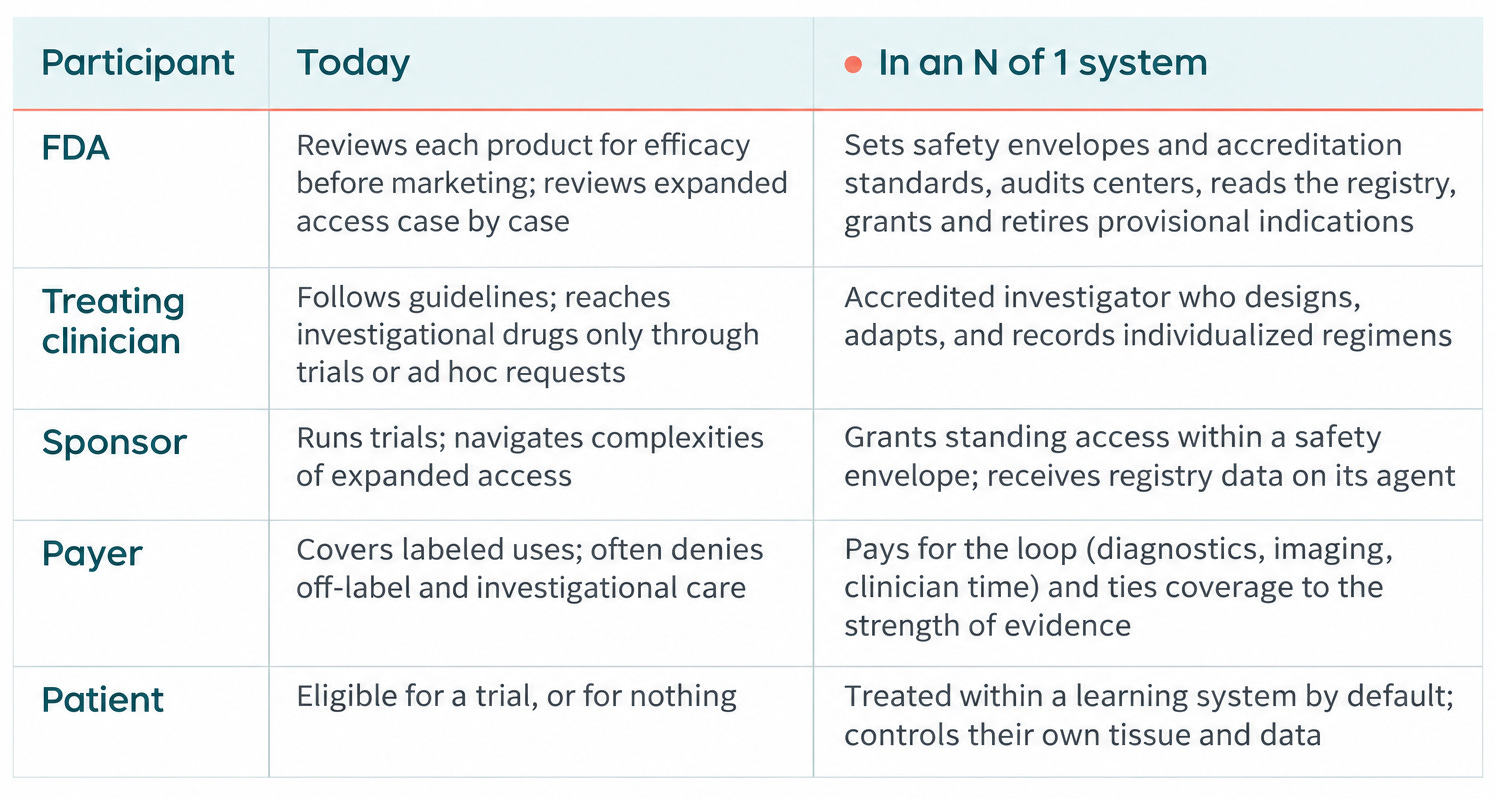
License the practice. Centers that treat patients on N of 1 regimens would be accredited, much as transplant centers are, and the clinician-investigators within them credentialed. Accreditation would require a molecular tumor board, pharmacologic and safety expertise, defined monitoring, and the infrastructure to capture data as care is delivered. Accredited centers would hold standing protocols, so that the FDA’s role shifts from approving each regimen to setting the boundaries within which regimens may proceed.
License the process. For an investigational agent, the sponsor and the FDA would agree after phase 1 on a safety envelope: the doses, combinations, and monitoring rules within which accredited centers may use the drug on notice rather than application, with the agency free to intervene at any point. For bespoke products, the object of review would be the validated system that designs and manufactures them. Platform technology designation, created in 2022, points in this direction but applies only to platforms already incorporated in an approved product. An individualized therapy license would let each patient-specific product made under a validated process be released after defined quality checks rather than through a new application.
Mandate the record. As in transplantation, every course at an accredited center would be reported to a national registry under a minimum data standard: the molecular rationale and comparator recorded before the first dose, imaging and circulating tumor DNA at fixed intervals, outcomes extracted from the record with validated methods, and failures reported as faithfully as successes. Within-patient comparisons, such as the progression-free interval ratio Daniel Von Hoff and colleagues used in 2010, help detect signals but cannot stand alone. Their strength comes from accumulation across many patients, analyzed with hierarchical methods specified in advance and set against historical controls. Center-level outcomes would be published, as they are for transplant centers.
Let the label live. The FDA would read the registry continuously. When evidence for an agent, or for a validated process, in a defined molecular context crosses a threshold set in advance, the agency would grant a provisional indication that expires by default unless continued accrual or a randomized study confirms it. The nearest existing relative is accelerated approval, which the Food and Drug Omnibus Reform Act of 2022 strengthened with authority to require confirmatory trials at approval and expedited procedures to withdraw. The difference is that evidence would arrive continuously from practice rather than episodically from trials, and the label would state not only the indication but the strength of the evidence behind it.
Each participant’s role changes accordingly:
Parts of this can begin now. Accredited centers can hold standing protocols under existing expanded access regulations, with a single review board and standard contracts. ASCO’s TAPUR study has run a working prototype since 2016, matching patients with advanced cancer to targeted drugs used outside their labels, with drugs contributed by manufacturers, review by a molecular tumor board, and results reported publicly, negative findings included. The FDA’s 2017 guidance on adverse events from expanded access, which noted that the agency knew of no case in which such events had blocked an approval, can be made explicit and binding for N of 1 protocols.
Full implementation and institutionalization would likely require Congress to create a statutory framework that borrows from transplant oversight while preserving the FDA’s authority over drug safety and manufacturing quality. Such a law would authorize accreditation and mandatory reporting with explicit privacy safeguards; create an individualized therapy license for validated design and manufacturing processes; and establish provisional indications that expire unless their evidence requirements are met. It would also give manufacturers narrowly defined liability protections and incentives, such as extended exclusivity or a priority review voucher, conditional on standing access and data sharing; fund the diagnostics, imaging, and clinician time required by the minimum data standard; and give patients a statutory right to direct the preservation and transfer of their own tissue and data.
Imagine how this would look from the clinic:
A woman with KRAS G12D pancreatic cancer progresses after first-line chemotherapy at a community hospital affiliated with an accredited center. Her sequencing and baseline scan are already in the record, and the center’s molecular tumor board reviews them that week. An investigational G12D inhibitor, past phase 1, is available under a standing authorization from its manufacturer. Her oncologist pairs it with an EGFR antibody, within the drug’s safety envelope, because her tumor’s profile suggests feedback through that receptor. The FDA receives a notification, not an application. Her scans and blood draws follow the registry’s schedule, and her outcomes are recorded without anyone filling out a form. She is one of four hundred such patients across sixty sites. When the pooled signal crosses its threshold, the agent receives a provisional indication in a precisely defined molecular context while a confirmatory trial enrolls. Her treatment was individualized. Her experience counted.
Several of these ideas echo what Sid argued from the other side of the system: that investigators should be free to choose their review board, that a drug which has completed phase 1 should reach patients whose DNA and RNA make them strong candidates, and that controls built for millions of doses should not be imposed on ten. Engineers can argue about architecture in the abstract indefinitely, he said, but show them two pieces of code and most will agree on which is better. Regulations change the same way: when a specific patient is standing at the door and the rule plainly does not fit.
None of this lowers the bar for safety. It changes what the regulator regulates. Since 1962, the object of oversight has been the molecule. In an N of 1 system it becomes the loop: the practitioner who runs it, the process that supplies it, the record it leaves behind, and the patient waiting on the other side.
VIII. The ledger of doubts
A proposal to reorder questions that were written into law after two tragedies deserves the skepticism those tragedies earned.
Conditional approvals can outlive their evidence. In 2014, Japan created a conditional, time-limited approval pathway for regenerative medicine, allowing products to reach patients on evidence of safety and probable benefit. Its first product, an autologous myoblast sheet for heart failure, was approved in 2015; nearly a decade later, regulators concluded that it had not met the criteria for full approval. Conditional authorization works only when its deadlines are enforced, its success criteria are fixed in advance, and failure carries consequences.
Concurrency obscures causation. When several interventions are given together and changed quickly, assigning credit to any one of them is difficult. Within-patient controls and hierarchical pooling narrow the uncertainty but do not eliminate it. The N of 1 pathway should feed randomized trials, not replace them, whenever pooled experience produces a signal strong enough to test.
The survivors write the history. Successes are visible; failures rarely are. A registry that records every course, including those that end badly, is the only defense against a literature composed of the lucky.
Desperation can be exploited. Patients with advanced cancer are vulnerable to unproven therapies sold at high prices. Qualified institutions, independent review, and public registration of every protocol are what separate a development pathway from a marketplace.
Access can become privilege. The most visible N of 1 successes so far have depended on extraordinary means. Jacob Stern named the ingredients of Sid’s path plainly: resources, risk tolerance, agency, and time. A pathway open only to a few would widen the very inequities that population medicine, for all its limitations, was designed to narrow. Some barriers persist at any price. Sid found it difficult even to obtain his own tumor tissue, which hospitals typically fix in paraffin, limiting later analyses, and are reluctant to release; Even One Ventures, the firm he and Jacob founded, started a company for that problem alone. The goal must be, and can be, a loop that grows cheaper, and simpler, with every patient who passes through it.
IX. What the average cannot know
Quetelet believed that the average man was the truth and that each living person was an error around it, an imperfect anomaly that nature did not intend to create. Medicine inherited a version of that belief. We built our evidence on the assumption that the signal lives in the population and the individual is noise to be averaged away.
What I’ve described here suggest the opposite. Every tumor carries a private history of mutation, adaptation, and escape that no average can contain. In modern medicine, the individual is the actual signal and the average is a mere approximation.
This doen’t make the randomized trial obsolete, any more than adjustable cockpits made aeronautical engineering obsolete. It means that the trial is one instrument among several, and that for the patient who has run out of options, it may be the wrong instrument to wait for. The alternative is not to abandon evidence. It’s to stop discarding it: to treat each individualized course as an experiment, record it as carefully as we would record a trial, and let the pattern emerge from the accumulation of single cases.
If the individual patient is the unit of generalization, the arithmetic of waste changes as well. Every patient treated without measurement is an experiment run and discarded. Every outcome left unrecorded is knowledge withheld from the next person with a similar tumor. The population model taught us to accept the control arm as the price of rigor. The N of 1 asks us to see the unmeasured patient as the price of bad habits.
KJ Muldoon will grow up as the only person who has ever received his medicine. Whether he is also the last person to benefit from it depends on whether we learn to read what his case, and thousands like it, can teach.
Sid Sijbrandij has now gone more than a year without detectable cancer. His team still images him regularly and tracks his disease status through blood-based minimum residual disease monitoring tests. Personalized vaccines continue to educate his immune system, and backup therapies stand ready in case the disease returns. His motto is two words: stay paranoid.
There is no finish line in the N of 1, only a loop that keeps turning: measure, decide, act, and measure again:
Medicine built for the average could offer an ending: a hazard ratio, a label, a line in a guideline. Medicine built for the individual offers something less final and more demanding, which is attention, sustained for as long as the disease keeps changing. A medicine for no one in particular was one of the great achievements of the last century. A medicine for someone in particular is harder, and it has no last page.
We’ve spent decades training physicians to follow guidelines. Today, we can, and must, follow the patient: to reason about one person’s data with the rigor once reserved for populations, to treat the outlier as the rule rather than the exception, and to go where the evidence leads.
For sixty years we have asked whether a drug works. The question for the next sixty should be whether we’re willing to learn from one patient at a time, for as long as it takes, and to let what we learn count as evidence.